Coadds
A coadd (also a stack or mosaic) combines several exposures of overlapping
sky into one image on a shared grid. It is deeper than any single exposure,
fills gaps between detectors, and removes defects that appear in only some
exposures. coadd does it in three
steps: plan a target grid,
resample each exposure onto it, and stack the resampled
pixels with per-pixel weights.
Use it for mosaics of calibrated, astrometrically registered exposures. The
inputs must already share a photometric scale (or carry photometric_scale)
and accurate WCS; coadd does not solve astrometry or photometric zero points.
For maps on the whole sphere use HEALPix mapmaking; for
a spectral third axis, cubes.
How It Works
flowchart LR
    O["exposures<br/>data, WCS, weight,<br/>mask / DQ"] --> P["plan<br/>target grid"]
    O --> B["background<br/>matching (optional)"]
    B --> X["outlier detection<br/>(optional): median,<br/>blot, compare"]
    X --> R["resample each<br/>exposure"]
    P --> R
    R --> S["stack per pixel<br/>weighted mean, median,<br/>sigma-clipped, …"]
    S --> M["MapResult<br/>data, weight, inverse_variance,<br/>context, provenance"]
For the default weighted mean, the value of target pixel \(j\) from exposures \(k\) with resampled data \(d_{kj}\) and weights \(w_{kj}\) is
Masked and flagged pixels get zero weight before resampling, so they never
enter the sum. A target pixel no exposure reaches has weight == 0.
What the resampled weight means. An interpolation kernel (bilinear, bicubic, Lanczos, Catmull-Rom, Mitchell-Netravali) resamples exposure \(k\) with coefficients \(c_{ij}\) over source pixels \(i\) with weights \(w_i\):
The weight is the kernel-weighted mean of the input weights. Near an image edge
the kernel taps that fall off the image are dropped and the remaining
coefficients are renormalised, so a constant inverse-variance map stays
constant up to the last covered pixel, whatever the sign of the dropped
taps. The coadd value is linear in the input pixels,
\(I_j = \sum_i a_{ij} x_i\), and inverse_variance is its exact diagonal
inverse variance \(1 / \sum_i a_{ij}^2 / w_i\) over all exposures. It exceeds
weight in the interior because interpolation averages neighbouring pixels
(see Uncertainty). SWarp and reproject also resample the
weight map with the data kernel, so interior weights equal the input inverse
variance in all three. Drizzle and conservative kernels instead give the covered
fraction of the input weight at footprint edges.
Weights are relative by default. A weight only sets each exposure's share of
the mean. Declare weight_is_inverse_variance=True when the weight map is
\(1/\sigma^2\) in data units; only then does the result carry
inverse_variance and an uncertainty product.
Validation. A coadd of 280 CFHT MegaCam CCDs onto an official UNIONS tile reproduces its aperture photometry within 2.1 mmag and centroids within 1 mas, and NIRCam coadds agree with SWarp and STScI drizzle; see performance highlights.
Four MegaPipe Tiles in One Mosaic
The MegaPipe example fetches four 512 × 512 g-band cutouts from three CFHT MegaPipe tiles, each with its own TAN projection, and coadds them with inverse-variance weights from each cutout's measured pixel noise.
# megapipe_mosaic_[abcd].fits: examples/megapipe_mosaic.py downloads them from CADC.
import torch
import torchfits

from torchsky.map import Observation, coadd, plan

def noise(image):
    """Per-pixel noise from adjacent-pixel differences (robust MAD)."""
    d = (image[:, 1:] - image[:, :-1]).flatten()
    return float(1.4826 * (d - d.median()).abs().median() / 2**0.5)

exposures = []
for name in ("megapipe_mosaic_a", "megapipe_mosaic_b", "megapipe_mosaic_c", "megapipe_mosaic_d"):
    image = torchfits.read(f"{name}.fits", 0).to(torch.float32)
    header = dict(torchfits.read_header(f"{name}.fits", 0))
    exposures.append(Observation(
        data=image, wcs=header,
        weight_map=torch.full_like(image, noise(image) ** -2),
        weight_is_inverse_variance=True,
    ))

target = plan(exposures, projection="TAN")    # one 712 x 868 grid covering all four
mosaic = coadd(exposures, target, kernel="lanczos3", method="weighted_mean")
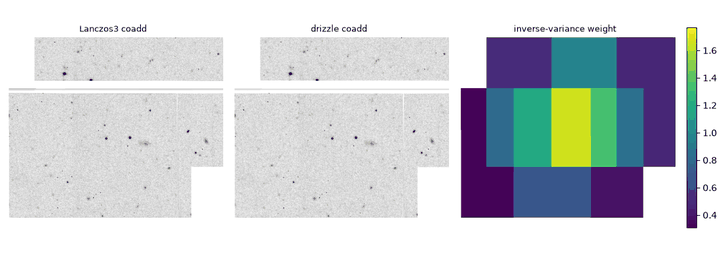
Where tiles overlap, they agree to a median offset below 0.002 counts, and the Lanczos-3 and drizzle mosaics correlate at 0.998 pixel by pixel.
JWST NIRCam Dithers Against the Pipeline Mosaic
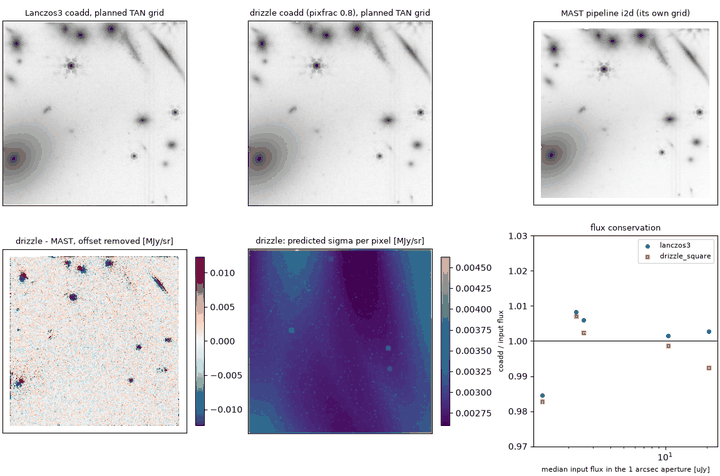
The SMACS 0723 example cuts
256 × 256 px around one sky position out of four dithered F444W calibrated
exposures on MAST (HTTP range reads, no full download). It keeps the
pipeline's SIP distortion, plans a grid aligned with the detector rows, and
coadds with cosmic-ray outlier rejection, once with Lanczos3 and once with
drizzle at pixfrac=0.8.
# fragment: observations are the four calibrated cutouts with background-limited weights
from torchsky.map import OutlierConfig, coadd, plan
from torchsky.wcs import WCS

angle = WCS(observations[0].wcs).position_angle()
target = plan(observations, projection="TAN", rotation_deg=angle)   # 258 x 257 px
drizzled = coadd(observations, target, kernel="drizzle_square", pixfrac=0.8,
                 semantics="surface_brightness", outliers=OutlierConfig())
Results:
- Flux. In 1 arcsec apertures, both coadds keep the median input flux to within 0.3 %.
- Noise. The noise in source-free pixels matches
1/sqrt(inverse_variance)to 1 % for Lanczos3 and 5 % for drizzle. - Pipeline. Drizzled onto the grid of the STScI level-3 mosaic, which uses all nine dithers, the coadd correlates with it at 0.9995 pixel by pixel. The aperture fluxes agree to 0.1 % and the centroids to 2 mas.
The weights there are a flux-independent inverse variance (read noise plus
sky). Weighting by 1/ERR², which includes source Poisson noise, gives the
bright pixels of every source less weight. That biases drizzle low and
Lanczos high by up to 20 % on bright stars.
A Weighted Coadd
import torch

from torchsky.map import Observation, ResampleConfig, StackConfig, coadd, plan

header = {
    "NAXIS": 2, "NAXIS1": 64, "NAXIS2": 64,
    "CTYPE1": "RA---TAN", "CTYPE2": "DEC--TAN",
    "CRPIX1": 32.5, "CRPIX2": 32.5, "CRVAL1": 150.0, "CRVAL2": 2.0,
    "CDELT1": -1e-3, "CDELT2": 1e-3,
}
gen = torch.Generator().manual_seed(1)
observations = [
    Observation(
        data=torch.randn(64, 64, generator=gen) + 10.0,
        wcs={**header, "CRVAL1": 150.0 + shift},
        weight_map=torch.full((64, 64), 4.0),
        weight_is_inverse_variance=True,
    )
    for shift in (0.0, 0.01, 0.02)
]

target = plan(observations, projection="TAN")
result = coadd(
    observations,
    target,
    resample=ResampleConfig(kernel="bilinear", semantics="surface_brightness"),
    stack=StackConfig(method="weighted_mean"),
)
covered = result.weight > 0
assert abs(float(result.data[covered].mean()) - 10.0) < 0.5
assert result.inverse_variance is not None
With files on disk, pass paths instead of tensors, for example
Observation("img_a.fits", weight_path="img_a_wht.fits"); torchfits reads
them. The torchsky map command line runs the same
workflow.
Recipes
Masks and data-quality flags
mask= is a Boolean map with True for usable pixels. dq= is an integer
data-quality (DQ) bit map, as delivered by HST and JWST pipelines; pixels
with any bit set outside good_bits get zero weight.
DQPolicy states
bit-level rules explicitly, and
build_weight_product
records weight and mask polarity when you build the planes yourself.
Match backgrounds
Exposures taken at different times have different sky levels. SkyConfig
removes them before stacking:
SkyConfig(mode=...) |
Removes |
|---|---|
"overlap_constant" ("constant", "match") |
one offset per exposure, solved jointly from the overlaps |
"overlap_planar", "overlap_mesh" |
a plane or a smooth mesh per exposure, from the overlaps |
"global" |
the common sky level of every exposure (absolute sky subtraction) |
"global+match" |
both: a global level, then relative offsets |
"per_exposure", "local" |
a mesh background estimated in each exposure alone |
Overlap matching only equalizes exposures; the mosaic keeps one undetermined
overall level. The fitted offsets appear in
result.provenance["observation_operators"].
Reject outliers
Cosmic rays, satellite trails, and other transients appear in one exposure only.
With outliers=OutlierConfig(), torchsky follows the AstroDrizzle and JWST
procedure: build a median coadd, blot
it back onto each exposure, and mask pixels that differ from it by more than
snr times the noise (plus scale times the local gradient), grown by grow
pixels. Declared inverse variance or variance planes give the noise model.
import torch

from torchsky.map import Observation, OutlierConfig, coadd, plan

header = {
    "NAXIS": 2, "NAXIS1": 64, "NAXIS2": 64,
    "CTYPE1": "RA---TAN", "CTYPE2": "DEC--TAN",
    "CRPIX1": 32.5, "CRPIX2": 32.5, "CRVAL1": 150.0, "CRVAL2": 2.0,
    "CDELT1": -1e-4, "CDELT2": 1e-4,
}
g = torch.Generator().manual_seed(0)
exposures = []
for i in range(4):
    data = 10.0 + 0.1 * torch.randn(64, 64, generator=g)
    if i == 1:
        data[30, 30] += 500.0                        # a cosmic-ray hit
    exposures.append(Observation(
        data=data, wcs={**header, "CRVAL1": 150.0 + 4e-4 * i},
        weight_map=torch.full((64, 64), 100.0), weight_is_inverse_variance=True,
    ))
target = plan(exposures)

plain = coadd(exposures, target, kernel="lanczos3")
clean = coadd(exposures, target, kernel="lanczos3", outliers=OutlierConfig())
assert float(plain.data.max()) > 100.0
assert float(clean.data[clean.weight > 0].max()) < 11.0
Choose a stacking method
method |
Result | Inverse variance |
|---|---|---|
"weighted_mean" (default) |
weighted mean | yes |
"sigma_clipped" |
weighted mean after iterative clipping (clip_sigma, clip_iterations) |
yes |
"mean", "median" |
unweighted mean or median of contributing exposures | no |
"min", "max", "sum" |
per-pixel extreme or sum | no |
"chi2" |
sum of squared signal-to-noise, for detection images | no |
Median and clipped stacks need every exposure's value per pixel at once; they
use on-disk scratch storage (scratch_dir=) that grows linearly with the number
of exposures.
Drizzle dithered exposures
For undersampled, dithered data, plan a finer grid and drizzle:
plan(exposures, pixel_scale_arcsec=...), then
coadd(..., kernel="drizzle_square", pixfrac=0.8). Inspect result.weight: a
strongly varying weight map means too few dithers for that pixfrac.
Uncertainty
With inverse-variance weights, result.inverse_variance is the diagonal
per-pixel inverse variance. Resampling correlates neighbouring pixels, so an
aperture sum is noisier than the diagonal suggests.
aperture_uncertainty
evaluates the exact detector-noise variance of a weighted aperture with the
adjoint of the same projection, without building a covariance matrix.
import torch

from torchsky.map import Observation, ResampleConfig, aperture_uncertainty, coadd, plan

header = {
    "NAXIS": 2, "NAXIS1": 64, "NAXIS2": 64,
    "CTYPE1": "RA---TAN", "CTYPE2": "DEC--TAN",
    "CRPIX1": 32.5, "CRPIX2": 32.5, "CRVAL1": 150.0, "CRVAL2": 2.0,
    "CDELT1": -1e-3, "CDELT2": 1e-3,
}
observations = [
    Observation(data=torch.ones(64, 64), wcs={**header, "CRVAL1": 150.0 + shift},
                weight_map=torch.full((64, 64), 4.0), weight_is_inverse_variance=True)
    for shift in (0.0, 0.01, 0.02)
]
target = plan(observations, projection="TAN")
resample = ResampleConfig(kernel="drizzle_square", pixfrac=0.8)
result = coadd(observations, target, resample=resample)

aperture = torch.zeros_like(result.data)
aperture[20:30, 20:30] = 1.0
noise = aperture_uncertainty(observations, result, aperture, resample=resample)
assert float(noise.variance) > 0.0
It fails closed for median or clipped stacks, data-dependent background fits, and Fourier kernels, whose noise is not a linear function of the inputs.
Tile large targets
coadd splits the target into tiles when the working set would exceed a memory
budget (30% of free device memory on CUDA, of available host memory on CPU),
processes only the tiles each exposure reaches, and accumulates one exposure at
a time. Set tile_size= explicitly, or change the budget with
TORCHSKY_TILE_MEMORY_BUDGET_BYTES (or tile_memory_budget_bytes= on
coadd_image_plane, the
engine behind coadd). A 10k × 10k UNIONS tile from 280 CCDs runs
in a single 12 GB GPU slice. See scaling and tuning.
Record and reuse a product definition
result.provenance records the kernel, semantics, stacking method, per-exposure
calibration (weights, scales, fitted background offsets), and the input
identities; result.context holds per-pixel bit masks of the contributing
exposures. ProductSpec
declares grid, bands, and semantics once, so that
stack_product calls on
different inputs give comparable products.
Pitfalls
- Relative versus inverse-variance weights. Without
weight_is_inverse_variance=Truethere is no uncertainty product, even if the numbers happen to be inverse variances. - Photometric scale. Exposures with different zero points need
photometric_scale; a coadd of mismatched units is a weighted mean of incompatible numbers. - Semantics. Compare with other stacks only at the same value semantics.
See Also
- Resampling: kernels, drizzle, semantics.
- HEALPix mapmaking and Cubes and IFU.
- Reference:
torchsky.map,StackConfig,SkyConfig,OutlierConfig. - Examples: MegaPipe mosaic, JWST SMACS 0723 dithers, dithered SIP coadd.