Sparse maps
A sparse HEALPix map stores values only on the pixels where you have data.
Survey depth, exposure counts, masks, and event counts at high resolution
cover a small fraction of the sky: at nside = 16384 (12.9 arcsec pixels) the
sphere has 3.2 billion pixels, and a dense float64 map would take 26 GB even if
only a few thousand pixels were observed.
SparseHealpixMap
keeps the sorted indices of the valid pixels and their values, and follows the
healsparse data model, so files and workflows carry over.
How It Works
The healsparse model has two resolutions:
nside_sparse, the resolution of the values.nside_coverage, a coarse grid (typically 32 or 64) that records which coarse pixels contain any data. Each coarse pixel owns a contiguous block of \((N_\mathrm{sparse}/N_\mathrm{coverage})^2\) NESTED children.
flowchart LR
    Q["sky position<br/>or pixel"] -->|"ang2pix<br/>(NESTED)"| P["pixel at<br/>nside_sparse"]
    P -->|"pixel ≫ 2·(order_sparse − order_cov)"| C["coverage pixel"]
    C -->|"covered?"| B["block of values"]
    C -->|"not covered"| S["sentinel"]
    B --> V["value or sentinel"]
A lookup is therefore a shift, a coverage test, and a gather: no search over
the whole map, and no dense allocation. Pixels with no data return the
sentinel (the HEALPix UNSEEN value, \(-1.6375 \times 10^{30}\), unless you
pass another), which is how "no data" stays distinct from a stored zero.
Values may carry leading dimensions, so a multi-band map is one object, and
from_columns builds named multi-column maps (weight, number of exposures,
fraction detected, …).
When to Use It
| Coverage and content | Use |
|---|---|
| Values on a small fraction of the sky at one resolution | SparseHealpixMap |
| Coverage only, any resolution, set algebra | MOC |
| Values whose resolution varies across the sky | MultiOrderHealpixMap (below) |
Full sky, or most of it, at modest nside |
A dense tensor of length \(12\,N_\mathrm{side}^2\) |
| Values for harmonic analysis | A dense RING map; see SHT |
The crossover is memory: a sparse map costs one int64 index plus the values per
valid pixel, so it wins once less than about half the sky is covered, and
overwhelmingly so at high nside.
Minimal Example: Depth of Overlapping Exposures
Two copies of a real CFHT MegaPipe cutout WCS (see
Projections), offset by half a cutout,
become coverage maps at nside = 16384. sum_union adds them on the union of
their pixels, giving the number of exposures per pixel.
import torch

from torchsky.sphere import SparseHealpixMap, sum_union
from torchsky.wcs import WCS

cutout = {  # CFHT MegaPipe 712.165 cutout WCS
    "NAXIS": 2, "NAXIS1": 512, "NAXIS2": 512, "CTYPE1": "RA---TAN", "CTYPE2": "DEC--TAN",
    "CRVAL1": 359.07190997, "CRVAL2": -7.5, "CRPIX1": -2999.0, "CRPIX2": 1001.0,
    "CD1_1": -5.160234650248e-05, "CD1_2": 0.0, "CD2_1": 0.0, "CD2_2": 5.160234650248e-05,
}
shifted = {**cutout, "CRPIX1": -2999.0 + 256}           # half a cutout further east

maps = [
    SparseHealpixMap.from_wcs(WCS(h), 2**14, shape=(512, 512), nside_coverage=32)
    for h in (cutout, shifted)
]
depth = sum_union(maps)

assert maps[0].valid_pixels.numel() < 100              # of 3.2e9 pixels on the sphere
assert depth.get_values(depth.valid_pixels).unique().tolist() == [1.0, 2.0]
values, valid = depth.lookup_radec(torch.tensor([358.89, 0.0], dtype=torch.float64),
                                   torch.tensor([-7.54, 0.0], dtype=torch.float64))
assert valid.tolist() == [True, False]                 # inside the footprint, far away
sum_intersection keeps only pixels present in every input.
from_observations builds survey-property maps (weight, nexp, fracdet)
from a list of Observation
objects in one call.
Real Data: Chandra Events
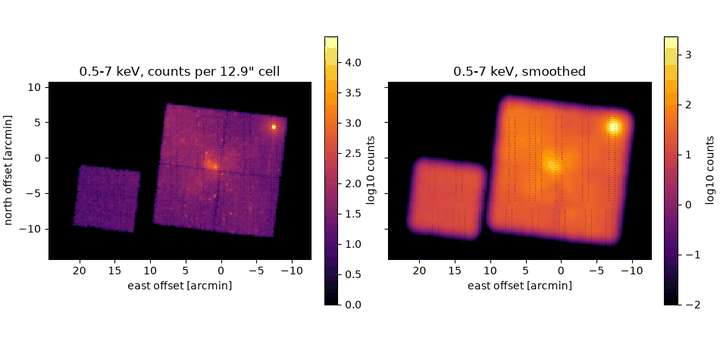
The Chandra example bins
the 324,000 events of ObsID 5950 in 0.5–7 keV into a counts map at
nside = 16384. 8,105 pixels are occupied, the event count is conserved, and
the map is then smoothed on the sparse pixel set with neighbors, never
touching a dense array.
# fragment: ra, dec are the event positions from the Chandra example
import torch
from torchsky.sphere import SparseHealpixMap, ang2pix

pix = ang2pix(2**14, ra, dec, nest=True, lonlat=True)
cells, counts = torch.unique(pix, return_counts=True)
counts_map = SparseHealpixMap.from_pixels(cells, counts.double(), 2**14, nest=True)
The footprint example
degrades the SDSS, GALEX, and eFEDS coverage MOCs to nside 256 and adds them
with sum_union into one
sparse map of survey depth. Its SDSS ∩ GALEX area, 13700 deg², is 5.4% above
the exact MOC intersection because a degraded cell counts as soon as any part
of it is covered.
Recipes
Build, Query, and Convert
import torch

from torchsky.sphere import SparseHealpixMap

nside = 16
dense = torch.randn(12 * nside**2, dtype=torch.float64)
sparse = SparseHealpixMap.from_pixels(
    pixels=torch.arange(100, dtype=torch.int64), values=dense[:100],
    nside_sparse=nside, sentinel=0.0,
)
assert sparse.valid_pixels.numel() == 100
assert sparse.get_values(torch.tensor([0, 99, 5000])).tolist()[2] == 0.0   # sentinel

nearest = sparse.interpolate(torch.tensor([0.0]), torch.tensor([0.0]), method="nearest")
assert nearest.shape == (1,)

back = sparse.to_dense(fill_value=0.0)
assert torch.equal(back[:100], dense[:100])
from_dense extracts the valid pixels of a dense map, from_moc and
from_region realize coverage, and update_values_pix adds or overwrites
pixels in place. interpolate supports "nearest" and "bilinear"; bilinear
drops uncovered neighbours and renormalizes the remaining weights.
Change Resolution
ud_grade(nside_out) degrades with averaging by default; power=-2 sums
(counts), pess=True marks a parent invalid unless all children are valid,
and reduction= selects other reductions. The coverage hierarchy is kept when
the output resolution allows it.
Move Between Values and Coverage
sparse.to_moc(), MOC.from_sparse_map, and MOC.to_sparse_map(nside,
nside_coverage=...) convert between values and topology at an explicit
resolution, never expanding a high-order MOC into dense pixels.
MOC.from_threshold keeps the pixels above or below a value, for example the
area deeper than a target exposure time.
import torch

from torchsky.sphere import MOC, SparseHealpixMap

depth = SparseHealpixMap.from_pixels(
    pixels=torch.arange(64, dtype=torch.int64),
    values=torch.ones(64, dtype=torch.float64), nside_sparse=16, sentinel=0.0,
)
footprint = MOC.from_sparse_map(depth)
again = footprint.to_sparse_map(nside=16, nside_coverage=2)
assert again.valid_pixels.numel() == 64 and again.nside_coverage == 2
Draw Randoms
sample_randoms(n, weights=...) draws points uniformly in solid angle inside
the valid pixels, or weighted by a column such as depth: the random catalog
for clustering measurements.
Read and Write Healsparse Files
write_fits writes the healsparse layout (COV and SPARSE images) through
torchfits; read_fits reads it back, or a PIXEL/VALUE table. to_healsparse
and from_healsparse convert at a boundary when healsparse is installed; it
is never a runtime backend.
Multi-Order Value Maps
MultiOrderHealpixMap
attaches values to sorted, disjoint UNIQ cells of mixed orders: the format of
gravitational-wave and neutrino localization maps, whose resolution follows
the probability density. values_are_densities=True declares values per
steradian, so integral(footprint) multiplies by cell area and by the covered
fraction of each cell. The integral is differentiable in the values.
import torch

from torchsky.sphere import MOC, MultiOrderHealpixMap, nest2uniq

uniq = nest2uniq(torch.tensor([1, 2]), torch.tensor([0, 4]))   # nside 1 and 2
density = torch.tensor([2.0, 3.0], dtype=torch.float64, requires_grad=True)
skymap = MultiOrderHealpixMap(uniq, density, values_are_densities=True)

probability = skymap.integral(MOC(nest2uniq(2, torch.tensor([0, 4]))))
probability.backward()
assert float(probability) > 0.0 and density.grad is not None
from_sparse_map/to_sparse_map exchange fixed-resolution maps and
from_columns/to_columns exchange UNIQ plus value columns. Host adapters for
mhealpy and cdshealpix copy to CPU; the tensor path has no peer
dependency.
Accuracy and Validation
Construction, lookups, ud_grade, and file round trips are compared with
healsparse in torchsky-harness;
see the parity page.
Pitfalls
- Sentinel versus zero. A stored
0and an uncovered pixel are different;lookup_radecandget_values_pos(..., valid_mask=True)return a validity mask next to the values. Boolean and integer maps keep a pixel list so an uncovered child is never read as a storedFalseor0. - NESTED only. Sparse maps index NESTED pixels; convert RING input first.
coverage_maskis a dense boolean array atnside_coverage(small);to_denseis the only full-resolution dense allocation.- Device. Lookups stay on the device of the map's tensors; a fused CPU gather is used when a coverage map is present.
See Also
- HEALPix, MOC, Celestial sphere overview.
- HEALPix mapmaking: coadd images into HEALPix maps.
- Reference:
SparseHealpixMap,MultiOrderHealpixMap,sum_union. - Examples: Chandra events, HEALPix and MOC, survey footprints.