Spherical harmonic transforms
A spherical harmonic transform (SHT) is the Fourier transform of the sphere. Any band-limited map \(f(\theta, \phi)\) is a sum of spherical harmonics \(Y_{\ell m}\), each a pattern with angular wavelength about \(180^\circ / \ell\):
Synthesis (alm2map) evaluates the sum on a HEALPix grid; analysis
(map2alm) recovers the coefficients \(a_{\ell m}\); the angular power
spectrum \(C_\ell\) measures the variance per multipole. torchsky.sphere
runs all three, plus beams, spin-2 (polarization) transforms, and masked-sky
spectra, on CPU, CUDA, and MPS without healpy at runtime.
When to Use It
- Measure the power spectrum of a full-sky or large-area map (CMB, Galactic foregrounds, galaxy density).
- Smooth, deconvolve, or filter a map by a function of \(\ell\) (beams, Wiener filters).
- Represent a sky model by its coefficients and fit them with gradients.
For a small patch of sky, a flat-sky FFT of a WCS image is cheaper and simpler. For local operations (a top-hat average, a point source) work in pixel space.
How It Works
On HEALPix the analysis integral \(a_{\ell m} = \int f\, Y^*_{\ell m}\, d\Omega\) becomes a sum over pixels. Pixels lie on iso-latitude rings, so the sum over longitude on each ring is an FFT, and the latitude part is an associated Legendre recurrence: cost \(O(N_\mathrm{side}^3)\) instead of \(O(N_\mathrm{side}^4)\).
lmax. It defaults to \(3N_\mathrm{side} - 1\), the largest multipole HEALPix can represent at all. Below about \(2N_\mathrm{side}\) the pixel sum is an accurate quadrature; between \(2N_\mathrm{side}\) and \(3N_\mathrm{side}\) aliasing grows. Chooselmaxfrom the map's beam rather than from the grid when you can.- Iterations. HEALPix quadrature is not exact.
iter=nruns \(n\) Jacobi refinements: synthesize, subtract, analyze the residual, add. Each costs one extra transform pair.use_weights=True(computed ring weights) anduse_pixel_weights=True(HEALPix full-pixel weight files read through torchfits fromdatapathorTORCHSKY_HEALPIX_DATAPATH) improve the quadrature instead; missing weight files raise.map2alm_lsqiterates to a residual tolerance and returns(alm, rel_res, n_iter)as a diagnostic. - Ordering. Coefficients use the healpy layout: complex, \(m \ge 0\) only,
in blocks of constant \(m\);
alm_index(ell, m, lmax)andalm_size(lmax)are the contract for indexing them. Real maps imply \(a_{\ell,-m} = (-1)^m a^*_{\ell m}\).
Minimal Example: Analysis, Synthesis, and Iterations
import torch
import torchsky.sphere as sphere

torch.manual_seed(0)
nside, lmax = 32, 64                              # lmax = 2 nside
ell = torch.arange(lmax + 1, dtype=torch.float64)
cl = torch.zeros(lmax + 1, dtype=torch.float64)
cl[2:] = 1.0 / ell[2:] ** 2

alm = sphere.synalm(cl, lmax=lmax)                # Gaussian a_lm with spectrum C_ell
sky = sphere.alm2map(alm, nside, lmax=lmax)       # (12 nside^2,) RING map

def error(n_iter: int) -> float:
    back = sphere.map2alm(sky, nside=nside, lmax=lmax, iter=n_iter)
    return float((back - alm).abs().max() / alm.abs().max())

assert error(0) < 1e-2 and error(3) < 1e-4       # 3e-3 -> 7e-6 with three iterations
assert alm.shape == (sphere.alm_size(lmax),)
assert sphere.alm_index(1, 1, lmax) == lmax + 1
Real Data: Planck Synchrotron on a Masked Sky
The Planck power spectrum example
reads the Commander synchrotron map (nside = 256, NESTED, Galactic), builds a
\(|b| > 20^\circ\) cut with query_strip, takes \(f_\mathrm{sky}\) from the
area of the cut's MOC, and compares full-sky and masked spectra:
# fragment: needs the cached sample; `pixi run fetch-example-samples` downloads it
from pathlib import Path

import torch
import torchfits
import torchsky.sphere as sphere

path = Path.home() / ".cache/torchsky/samples/planck_commander_sync_256.fits"
sky = torchfits.read(str(path), hdu=1)["I_MEAN"].to(torch.float64)
cl_full = sphere.anafast(sky, nest=True, lmax=383)            # C_ell ~ ell^-1.8
clean = sphere.remove_monopole_dipole(sky, 256, nest=True, valid_mask=weight > 0)
w2 = float((weight * weight).mean())  # weight: |b| > 20 deg, 10 deg cosine taper
cl_cut = sphere.anafast(clean * weight, nest=True, lmax=383) / w2
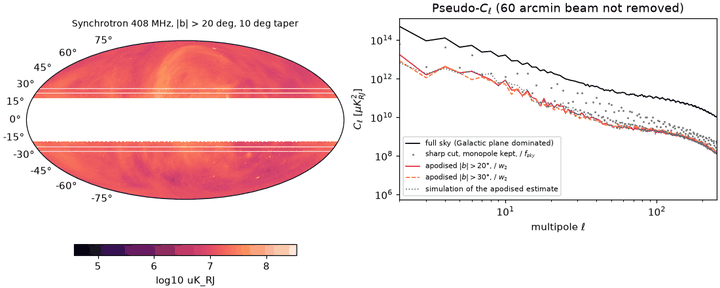
The mask is apodised with a 10° cosine taper, the monopole and dipole are removed on the unmasked sky, and the pseudo-\(C_\ell\) is divided by \(w_2\), the mean of the squared mask. On Gaussian simulations masked the same way this recovers the input spectrum to within 4 % above \(\ell = 30\). The real high-latitude spectrum still lies 30–60 times below the full-sky one. That is physical, not a normalisation error: most synchrotron power sits in the Galactic plane, which the mask removes, so the high-latitude sky is not a statistically isotropic sample of the full sky.
Recipes
Power Spectra and Cross-Spectra
anafast(map1, map2=None, ...) goes from maps to \(C_\ell\); alm2cl works on
coefficients you already have. Polarized input is (3, npix) in (T, Q, U)
order and returns spectra in healpy's stacked order (TT, EE, BB, TE, EB, TB);
pass alm=True to receive the coefficients too.
import torch
import torchsky.sphere as sphere

torch.manual_seed(1)
nside, lmax = 16, 8
a = sphere.synfast(torch.ones(lmax + 1, dtype=torch.float64), nside=nside, lmax=lmax, pol=False)
b = a + 0.1 * torch.randn_like(a)

cl_map = sphere.anafast(a, nside=nside, lmax=lmax, pol=False)
cl_alm = sphere.alm2cl(sphere.map2alm(a, nside=nside, lmax=lmax), lmax=lmax)
torch.testing.assert_close(cl_map, cl_alm, rtol=1e-10, atol=1e-12)

cross = sphere.anafast(a, b, nside=nside, lmax=lmax, pol=False)
assert cross.shape == (lmax + 1,)
Beams, Filters, and Smoothing
gaussian_beam(fwhm_rad, lmax) returns \(B_\ell\); almxfl(alm, f_ell)
multiplies coefficients by any function of \(\ell\); smoothmap analyzes,
filters, and synthesizes in one call and also takes a measured beam= or
beam_window=. smoothalm keeps a coefficient-space pipeline.
import math

import torch
import torchsky.sphere as sphere

torch.manual_seed(2)
nside, lmax = 16, 32
ell = torch.arange(lmax + 1, dtype=torch.float64)
sky = sphere.synfast(torch.exp(-ell / 10), nside=nside, lmax=lmax, pol=False)

fwhm = math.radians(5.0)
beam = sphere.gaussian_beam(fwhm, lmax)
smoothed = sphere.alm2map(sphere.almxfl(sphere.map2alm(sky, nside=nside, lmax=lmax), beam),
                          nside, lmax=lmax)
assert float(smoothed.std()) < float(sky.std())
one_call = sphere.smoothmap(sky, nside=nside, lmax=lmax, mmax=lmax, fwhm_rad=fwhm)
assert one_call.shape == sky.shape

window = sphere.pixwin(nside, lmax=lmax)          # HEALPix pixel window function
assert abs(float(window[0]) - 1.0) < 1e-6 and float(window[-1]) < 0.9
The pixel window \(W_\ell\) is the transfer function of averaging over a HEALPix pixel. Following the definition behind the HEALPix tables, \(W_\ell^2\) is the mean over pixels of each pixel's harmonic power,
pixwin computes it for any
nside up to 8192 and \(\ell \le 4\,n_\mathrm{side}\) from the pixel shapes,
with no tables. With \(t = (1 - \hat n\cdot\hat n')/2\), \(P_\ell(1-2t)\) is
a terminating hypergeometric series in \(t\), so \(W_\ell^2\) is a short sum
of pixel-averaged moments \(\langle t^k\rangle\) with a rigorous truncation
bound. The moments are integrated with Gauss–Legendre rules on every distinct
pixel shape (pixels at the poles and on the polar-cap boundary are split into
triangles). pol=True adds the spin-2 window from \(d^\ell_{22}\), with the
polarization frame parallel-transported across the pixel.
- Accuracy: to \(10^{-12}\) or better. It reproduces the healpy tables to
\(10^{-12}\) for
nsideup to 128. Fornside256 to 2048 the healpy tables differ by up to \(1.3\times10^{-5}\), an error in the tables: \(1 - W_\ell\) here keeps its exact \(n_\mathrm{side}^{-2}\) scaling, and an independent transform of every pixel's indicator map converges to the same values. The healpy polarization windows use a frame convention that differs by \(10^{-6}\) atnside8, falling as \(n_\mathrm{side}^{-4}\). - Cost: \(O(n_\mathrm{side}^2)\) once per
nside, on the CPU: under a second up tonside256, about 15 s at 1024 and a minute at 2048 on a laptop CPU. Results are cached in memory and, fromnside256, in$TORCHSKY_CACHE_DIR/pixwin(default~/.cache/torchsky/pixwin).
import torchsky.sphere as sphere

w_t, w_p = sphere.pixwin(64, pol=True)              # l = 0 .. 191
assert w_t.shape == w_p.shape == (192,) and float(w_p[1]) == 0.0
w_ratio = (1.0 - sphere.pixwin(128)[2]) / (1.0 - w_t[2])
assert abs(float(w_ratio) - 0.25) < 1e-3            # 1 - W_l at fixed l ~ nside^-2
Polarization (Spin 2)
Polarization \(Q \pm iU\) has spin \(\pm 2\); its transform yields gradient
(E) and curl (B) coefficients, which, unlike \(Q\) and \(U\), do not depend
on the coordinate frame. map2alm(iqu, pol=True) returns (3, nalm)
coefficients in (T, E, B) order.
map2alm_spin(qu, spin=2) works on a (2, npix) Q/U pair and returns the
(E, B) pair; alm2map_spin goes back. Spins must be non-negative integers.
import torch
import torchsky.sphere as sphere

torch.manual_seed(3)
nside, lmax = 16, 24
cl = torch.ones(lmax + 1, dtype=torch.float64)
cl[:2] = 0.0
teb = torch.zeros(3, sphere.alm_size(lmax), dtype=torch.complex128)
teb[1] = sphere.synalm(cl, lmax=lmax)                   # pure E mode
iqu = sphere.alm2map(teb, nside, lmax=lmax, pol=True)

e, b = sphere.map2alm_spin(iqu[1:], 2, nside=nside, lmax=lmax, iter=3)
assert float((e - teb[1]).abs().max()) < 1e-3          # E recovered
assert float(b.abs().max()) < 1e-3                      # no B leaks in
assert sphere.alm2map_spin((e, b), nside=nside, spin=2, lmax=lmax).shape == (2, 12 * nside**2)
Masked Skies: Pseudo-\(C_\ell\)
A mask couples multipoles: the spectrum of a masked map, the pseudo-\(C_\ell\),
is \(\tilde C_\ell = \sum_{\ell'} M_{\ell\ell'} C_{\ell'}\), with a coupling
matrix \(M\) set by the mask's own spectrum. Dividing by \(f_\mathrm{sky}\)
(as in the Planck example) is the zeroth-order correction. The MASTER method
inverts \(M\) on bandpowers:
ModeCouplingWorkspace
computes it exactly in correlation space, without an \(\ell \times \ell\)
kernel, for scalar and spin-2 fields on CAR grids
(CARGeometry).
PseudoClField
carries the map, mask, beam, pixel window, and optional E/B purification and
template deprojection.
import torch

import torchsky.sphere as sphere
from torchsky.sphere import (BandpowerBinning, CARGeometry, ModeCouplingWorkspace,
                             PseudoClField, coupled_spectra, synthesize)

torch.manual_seed(0)
lmax = 16
nlat, nlon = 2 * lmax + 1, 4 * lmax + 1
geometry = CARGeometry.from_header({
    "NAXIS1": nlon, "NAXIS2": nlat, "CTYPE1": "RA---CAR", "CTYPE2": "DEC--CAR",
    "CRVAL1": 0.0, "CRVAL2": 0.0, "CRPIX1": 1.0, "CRPIX2": (nlat + 1.0) / 2.0,
    "CDELT1": 360.0 / nlon, "CDELT2": -180.0 / (nlat - 1),
}, spin_convention="iau")

lat = geometry.latitudes(dtype=torch.float64, device="cpu")       # one per row
mask = torch.sigmoid((lat.abs() - 0.44) / 0.15).reshape(-1, 1).expand(geometry.shape)  # |b| > 25 deg

ell = torch.arange(lmax + 1, dtype=torch.float64)
cl_true = 1.0 / (ell + 3.0) ** 2
binning = BandpowerBinning.from_edges([2, 6, 10, 17], lmax)
estimates, workspace = [], None
for _ in range(30):
    sky = synthesize(sphere.synalm(cl_true, lmax=lmax), geometry, lmax=lmax).values
    field = PseudoClField(sky, mask, geometry, lmax)
    if workspace is None:                         # the mask fixes the coupling
        workspace = ModeCouplingWorkspace.from_fields(field, None, binning)
    estimates.append(workspace.decouple(coupled_spectra(field)))

ratio = torch.stack(estimates).mean(0) / binning.bin(cl_true)
assert bool(((ratio - 1.0).abs() < 0.25).all())   # unbiased within the scatter of 30 skies
Explicit Geometry and Backends
SHTRequest binds a
geometry (HEALPixGeometry
or CARGeometry), a bandlimit, and a spin convention; synthesize,
adjoint_synthesize, analyze, and pseudo_analyze dispatch through a
backend that reports its SHTBackendCapabilities. Unsupported combinations
fail: CARGeometry, for example, accepts only separable, unrotated,
full-longitude grids with Clenshaw-Curtis or Fejér-1 latitude rings. This is
the entry point for matrix-free and differentiable solvers whose maps are not
HEALPix.
Devices, Precision, and Memory
CPU uses fused C++ kernels; CUDA and MPS use an ATen ring-FFT path and keep
maps on the device. TORCHSKY_DISABLE_CPP=1 selects the pure-torch path with
the same results. lmax up to \(3N_\mathrm{side} - 1\) works at every nside: the Legendre
recurrence carries a power-of-\(2^{256}\) exponent per (m, ring), so the
sectoral seed \(\sin^m\theta\) never underflows float64, and rings where
\(m > \ell_\mathrm{max} \sin\theta\) plus a WKB margin are skipped (dropped
weight below \(e^{-90}\)). MPS has no float64: the spin-weighted Legendre
recurrence runs on the host in float64 and returns float32/complex64 tensors
on the MPS device.
TORCHSKY_SCALAR_MAX_CACHE_BYTES (default 512 MiB) bounds the cached basis
matrices; TORCHSKY_SPIN_THREADS caps the CPU spin thread pool.
Accuracy and Validation
Transforms, spectra, beams, and pixel windows are checked against healpy in
torchsky-harness, at
nside 512, 1024, and 2048 up to lmax = 6143; see the
parity page. Mode-coupling matrices are tested
against direct Wigner-3j sums.
Pitfalls
pol=Trueshapes are validated, not inferred:(3, npix)maps and(3, nalm)coefficients in(T, E, B)order.- Monopole and dipole dominate many real maps and leak under a mask;
remove them first with
remove_monopole_dipole. rotate_almrequiresmmax == lmaxand uses the healpy ZYZ Euler convention.- NESTED maps need
nest=True; analysis reorders internally.
See Also
- HEALPix, MOC (masks and \(f_\mathrm{sky}\)), Celestial sphere overview.
- Fields: harmonic sky models fitted with gradients.
- Reference:
torchsky.sphere, healpy-shapedcompat. - Examples: Planck power spectrum, SHT power spectrum, T/E/B polarization.